
A Likely Corporate Blind Spot: Why Emergency Response Teams (ERT) Matter & What Are They?
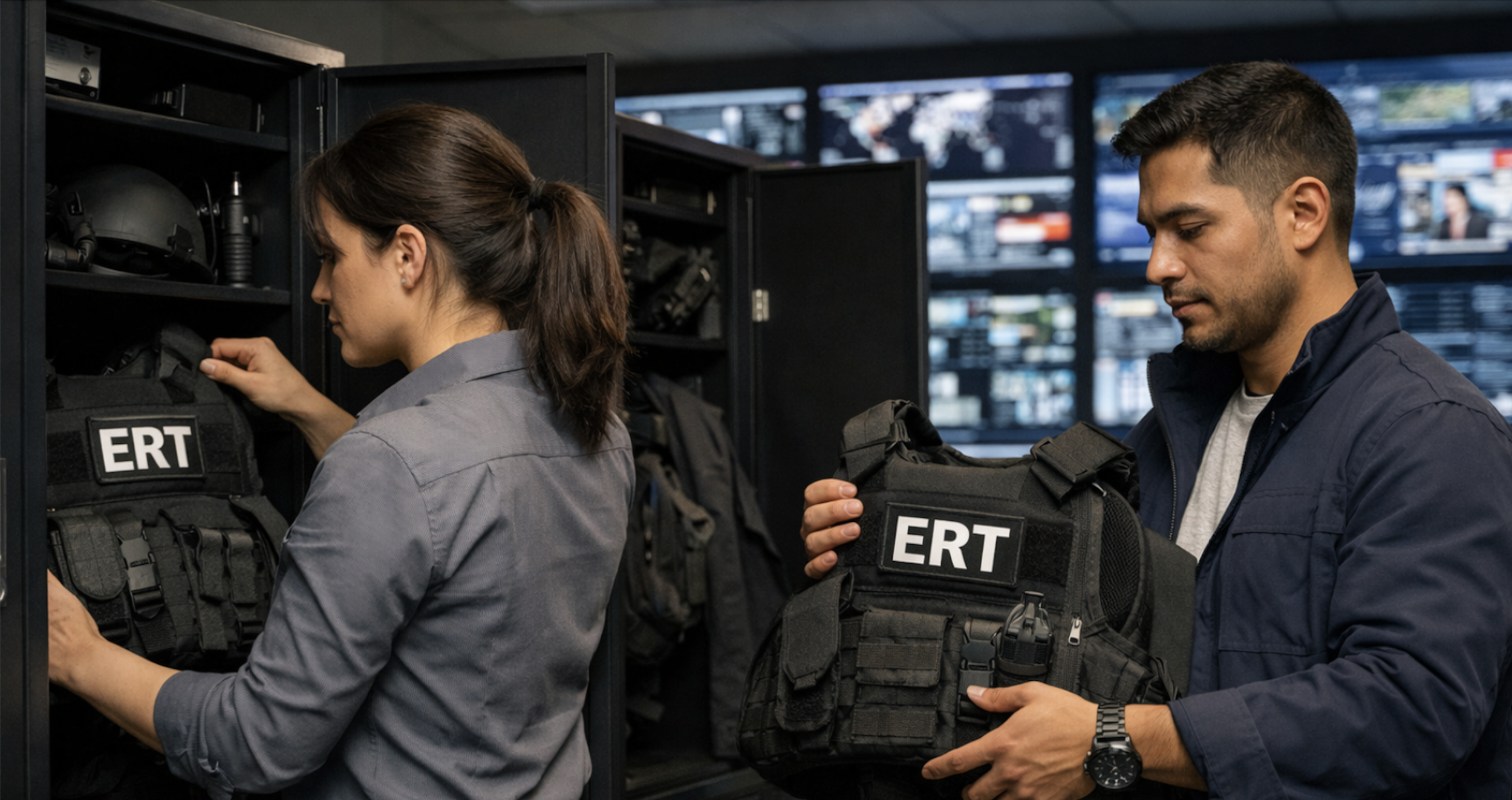
ERTs Aren’t Just Safety, They’re Strategic
The term Emergency Response Team (ERT) is familiar, often linked to a diverse range of sectors and responsibilities. But in the corporate world, ERTs are often misunderstood, underfunded, undervalued, and underutilized. They may be treated as a compliance function, a box to check to meet minimum requirements. In some cases, they get buried under “Facilities,” or another department lacking subject-matter expert leadership, or, worse, treated like a guard force or basic building security, and forgotten until something goes wrong.
An Emergency Response Team (ERT) is a designated, highly trained group of professionals responsible for responding quickly to emergencies to protect life, property, and business operations until professional responders (fire, police, EMS) arrive, assume control, or work alongside them.
Maximizing the Value of a Modern ERT
A contemporary, tailor-made corporate Emergency Response Team (ERT) should be structured as a comprehensive, high-value asset with reach and consistent interoperability across an organization. However, it should fit the mold, be justifiable, and be a constant value add. Those designing and owning the program should understand how to integrate it into overall enterprise-level operations and be subject-matter experts in relevant operations.
ERT can be branded with any name that inspires confidence and clarity, but its core function should remain the same.
What it could look like is a non-obtrusive, plain-clothes group of highly trained, carefully selected personnel. The scope of a modern ERT could be extensive and include:
Active shooter response.
Active threat and lockdown support.
Workplace violence prevention and response.
Standby for hostile termination procedures.
Escorting at-risk employees.
Environmental emergencies.
Special event security and executive protection support during VIP visits.
Providing rapid medical stabilization (including CPR/AED and trauma care) until law enforcement or EMS arrives. This is due to a higher level of experience and training capability (EMT-B or EMT-P)
Success hinges on several critical steps: formally designating members, clearly defining the team’s purpose, authority, and limitations within established policy, compliance, and committing to ongoing capability development through rigorous, scenario-based, and cross-functional training cycles. When executed properly, an ERT transforms into a measurable value-add with a clear and justifiable return on investment.
The Reality of Emergency Response Teams
ERTs should be built to serve as your first, and sometimes only, line of defense during a real crisis. A formally structured and trained corporate ERT is an advanced capability within a broader Protective Operations vertical. They are the only people on-site, trained, equipped, and positioned to respond in the first critical minutes of critical campus and facility situations.
Not 911.
Not Your Access Control Personnel
Not an Onsite GSOC or Offsite Protection Team
Not Your Event Security Department
Not Your Legal Team.
Not Your Executives
Your Emergency Response Team
Because when something happens, the first few minutes belong to whoever is already there.
The Blind Spot No One Talks About
Security infrastructure can look impressive on paper:
Surveillance cameras with AI integration
Access control and biometrics.
Alarms and analytics dashboards.
GSOC Teams with 24/7 monitoring and support & software to match.
But here’s the problem: none of that stops an unfolding incident by itself.
There’s a dangerous gap between the moment something starts and the moment external first responders arrive. That gap is where outcomes are decided. And in that gap, your Emergency Response Team becomes the bridge between chaos and control.
They’re the ones addressing high-risk personnel or threats, evacuating employees, suppressing fires, applying life-saving first aid, and making the calls that either contain the situation or allow it to escalate.
The “We’re Only a Few Floors” Myth
One of the most common assumptions we hear is:
“We’re in a major corporate building. Security is handled.”
That mindset is a liability.
Being a tenant doesn’t remove responsibility. It often creates a false sense of coverage. Building security is typically designed to protect the property and manage general access. It is not built to understand your people, threats, internal dynamics, or organizational risk.
If you occupy two floors or twenty, you still own the outcomes inside your space.
And if you think “it won’t happen here,” it’s worth remembering incidents like the one at the NFL office. High-profile buildings, major cities, professional environments — none of those things prevent violence, instability, or targeted incidents from reaching your doorstep.
The Risk Nobody Plans For: Terminated Employees
A major blind spot in corporate preparedness isn’t just an earthquake or a fire.
It’s the human element.
Organizations spend enormous effort hiring, onboarding, and building culture. But many fail to treat offboarding and termination as the high-risk operational moments they are, as well as the days and weeks to follow.
Terminated employees can present real risk when the separation is emotional, sudden, financially stressful, or perceived as unfair. That risk doesn’t always look like violence. Sometimes it shows up as:
attempts to re-enter the workplace
confrontations in the lobby or parking area
harassment of leadership or HR
threats made online or to coworkers
sabotage, theft, or retaliation
If your ERT and security teams are not aligned with HR and leadership on termination procedures, access removal, and response protocols, you’re gambling with everyone's safety who still works there. This has become a major concern as we are seeing different major tech organizations consistently laying off 15% - 30% of their workforce every few months.
Underfunded Security Can Be Worse Than No Security
There’s another reality leaders don’t like to hear:
A poorly budgeted physical security team can create more risk than not having one at all.
Why?
Because a half-built program creates the illusion of readiness without the capability to deliver it.
Undertrained personnel, unclear authority, inconsistent coverage, outdated procedures, and low-confidence response can lead to hesitation at the worst possible time. Worse, it can lead to decisions that escalate an incident rather than stabilize it.
If you’re going to invest in security and emergency response, it has to be real. Not symbolic.
Strategic Leaders Think Differently
We work with some of the most respected and security-conscious organizations in Silicon Valley, especially in AI and advanced tech.
Here’s what we consistently see among top-performing executive teams:
They don’t treat ERTs as a side project.
They integrate response readiness into business continuity and enterprise risk.
They assign ownership at the leadership level, not just mid-management.
Because they’ve learned the hard lesson that too many companies discover too late:
You can outsource technology.
You can outsource training.
But you cannot outsource accountability when something happens in your space.
Effective emergency response isn’t transactional.
It’s built on familiarity, trust, and shared responsibility.
It's becoming part of the organization's critical infrastructure.
The ROI No One Can Ignore
When Emergency Response Teams do their job well, nothing happens.
No evacuation.
No headlines.
No lawsuit.
No downtime.
That’s success. But it’s invisible.
Until something goes wrong, and suddenly everyone wishes they had invested more.
Executives who treat ERTs like a “soft function” are often stunned by the hard financial impact when preparedness fails:
billions in halted operations
reputational damage that erodes investor trust
lawsuits, fines, and regulatory scrutiny
and worst of all, avoidable harm to employees
The Shift: From Checkbox to Strategic Advantage
We help leading AI and tech companies transform ERT programs into elite internal capabilities. Not just compliant, but proactive, integrated, and ready.
That includes:
customized ERT program development
executive-level visibility and ownership
cross-functional alignment (Security, Facilities, HR, Legal, Operations)
high-fidelity drills and after-action reviews
real-time performance metrics and risk modeling
Let’s Be Honest
If you’re a Director, VP, or Executive evaluating internal response readiness, ask yourself this:
“If something happened on-site today, who is trained to act before help arrives?”
If you can’t answer that confidently, you have a gap.
Let’s close it before you have to explain it after a crisis.
We help organizations build internal readiness as part of a broader resilience strategy.
If you're building in AI, tech, or innovation, we’d love to share what we’ve seen work best.
Let's Talk.
